
theology
Who Holds the Ridge? Women in Office and the Order of Creation
Arne Verster22 min read
Contents10 sections
Aa
In 1942 the world was at war. That July, South African soldiers of the 1st Division dug in at El Alamein in the Egyptian desert. With other Allied troops, they held the line between the German and Italian armies and the Suez Canal. At the same time, on the other side of the world, a different fight began over an island that few people could find on a map.
Guadalcanal is a long, green island in the Solomon Islands, north-east of Australia. In July 1942 the Japanese navy started to build an airfield there. From that airfield, Japanese bombers could cut the sea route between the United States and Australia. On 7 August 1942, about 11,000 United States Marines landed on the island. The next day they took the unfinished airfield. They named it Henderson Field, after a Marine pilot who was killed at the Battle of Midway two months before. For the next six months, Japan tried to take it back.
The Marines lived in mud and rain. Malaria, dysentery and poor food put far more men in hospital than enemy fire did. At night Japanese warships came close to the coast and shelled the Marine positions. Sailors called the sea north of the island "Iron Bottom Sound," because so many ships sank there.
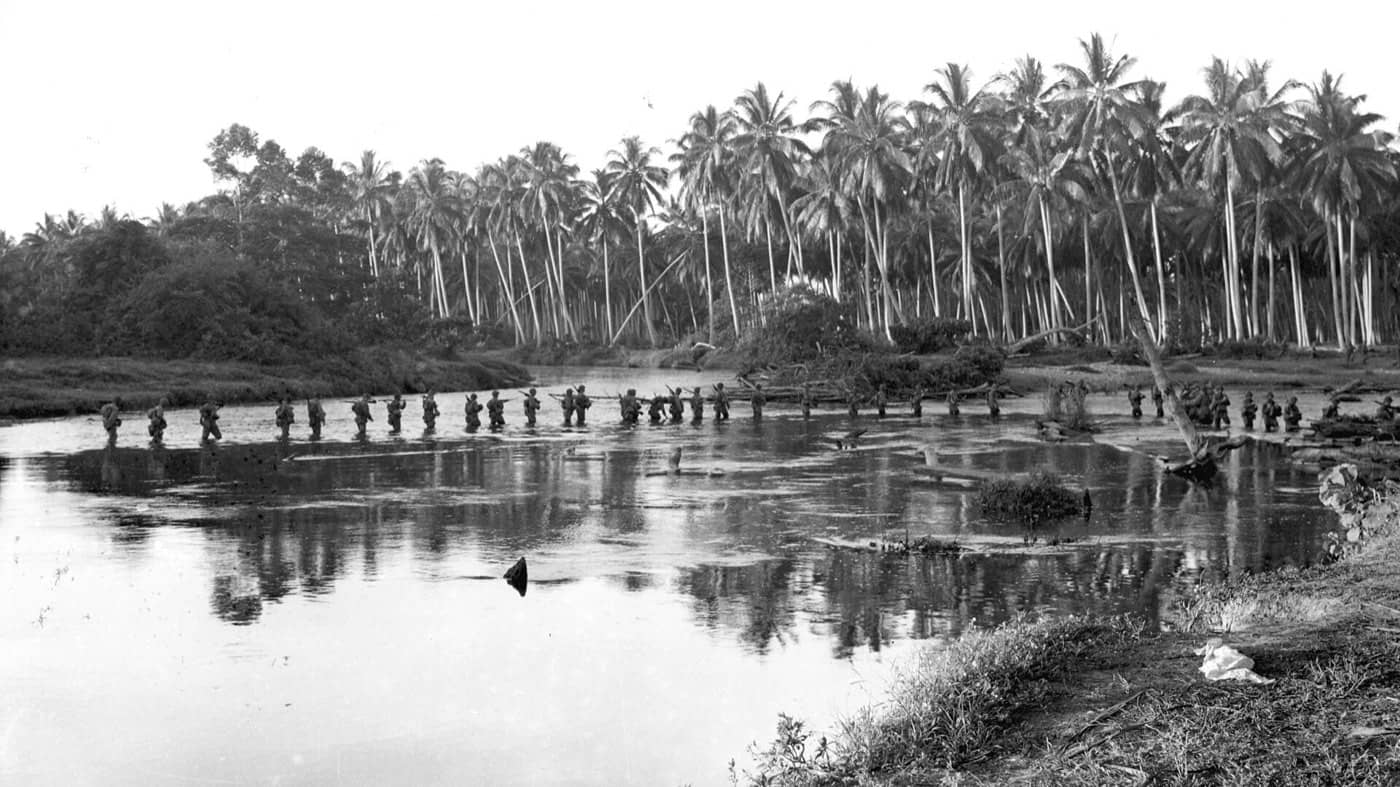
Marines wade a river on patrol on Guadalcanal in August 1942.
The Night on the Ridge
In September 1942, a Japanese general named Kiyotake Kawaguchi brought between 2,000 and 3,000 men through the jungle to attack the airfield from the south. Between his men and Henderson Field was a low ridge of grass and coral. Fewer than a thousand Marines held it.
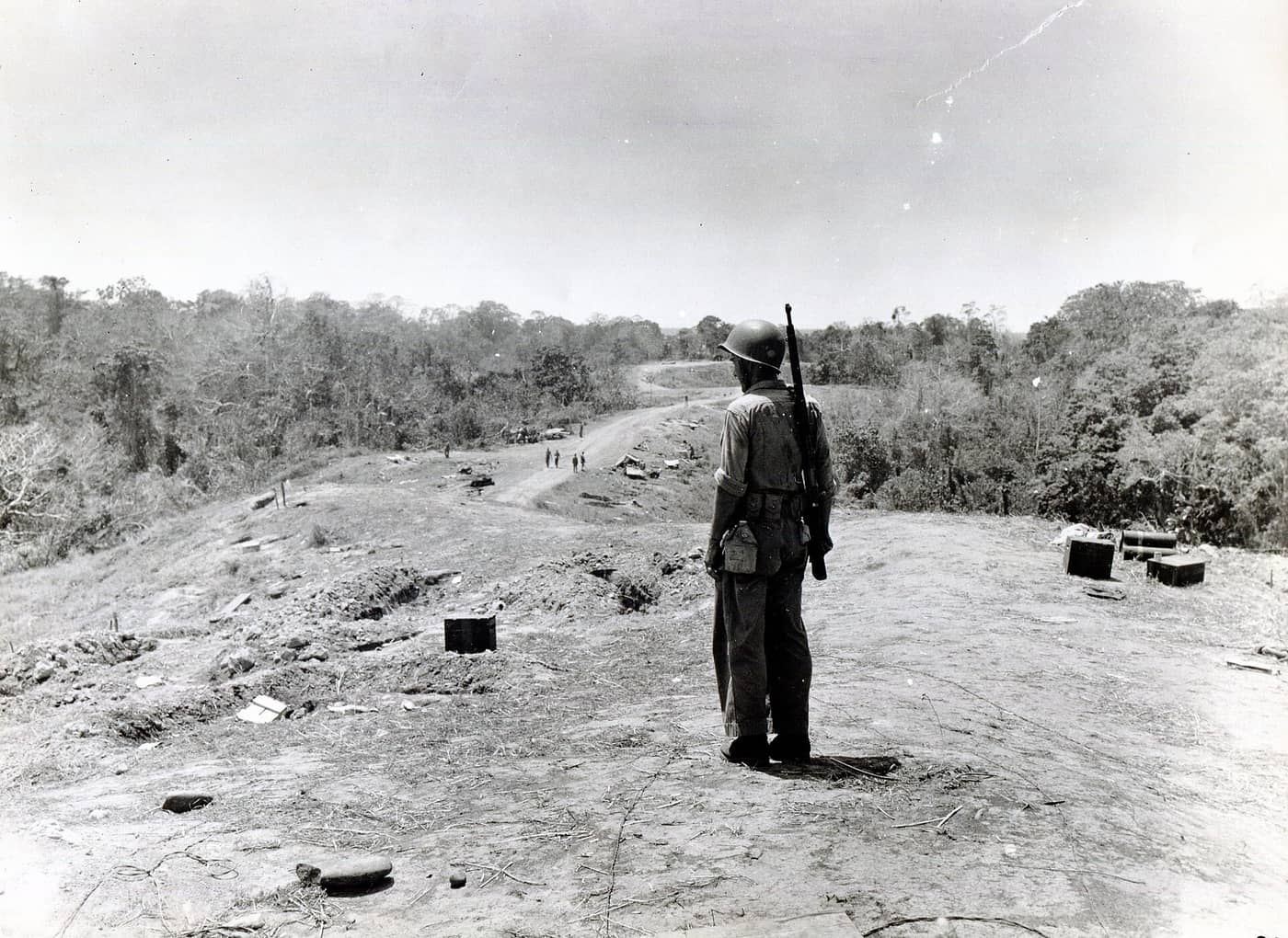
A Marine stands guard on Bloody Ridge on 15 September 1942, the day after the battle. He looks along the ridge toward the airfield.
Their commander was Colonel Merritt Edson. His men called him "Red Mike" because of his red beard. Edson led the 1st Raider Battalion, a small unit trained for the hardest tasks.
On the nights of 12 and 13 September, wave after wave of Japanese soldiers attacked up the slopes. Japanese ships shelled the ridge from the sea. Edson stood close behind his line all night. He moved men, closed gaps and gave orders under fire. The Marines fell back step by step until they reached the last hill before the airfield. There Edson held them. In the morning the attack was broken. History now calls the place "Edson's Ridge," or "Bloody Ridge." Edson received the Medal of Honor, America's highest award for bravery. In February 1943, Japan gave up and took its last soldiers off the island.
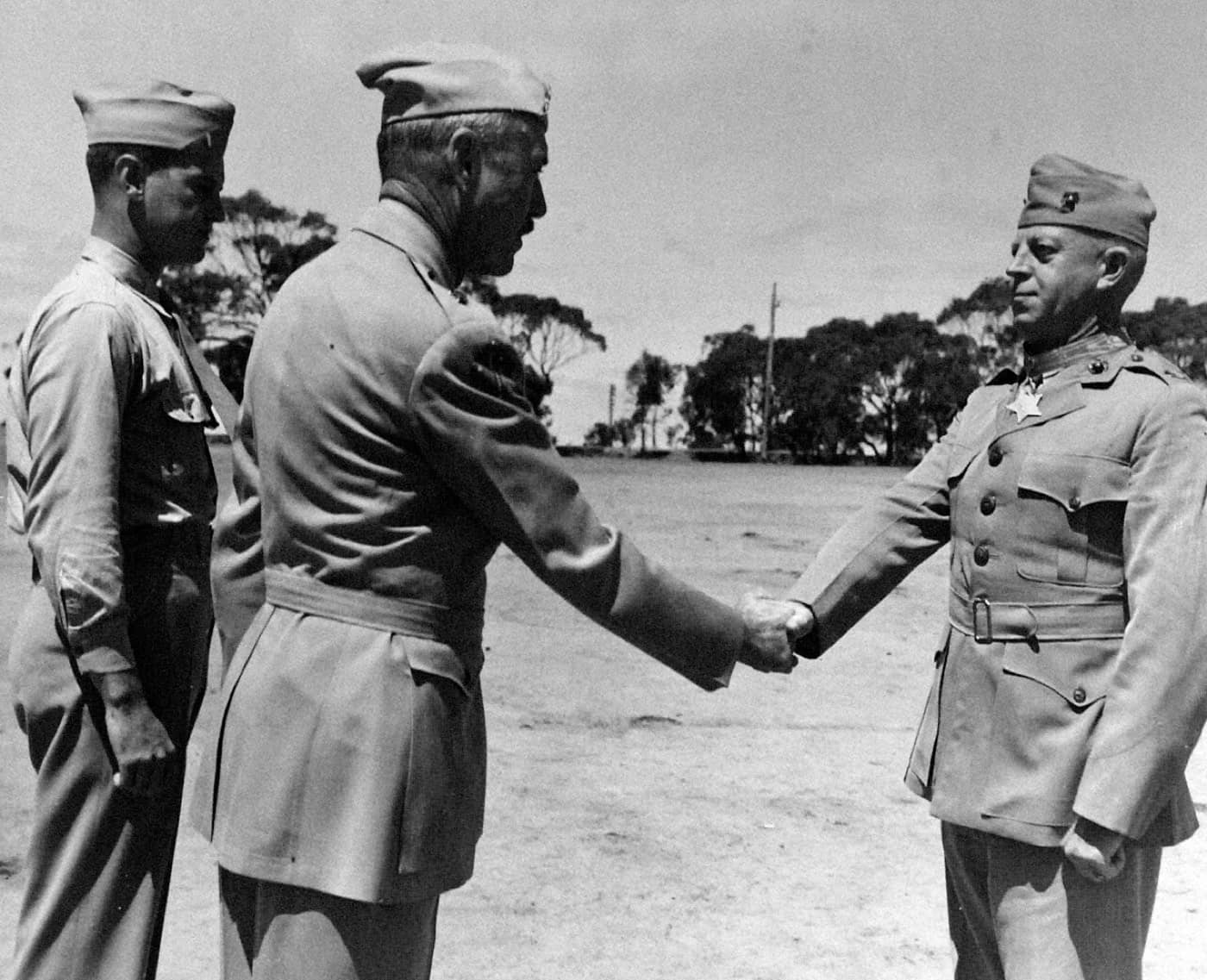
Colonel Merritt Edson (right) wears the Medal of Honor in 1943, a year after the battle on the ridge.
Edson did not hold that ridge because he was the strongest man on it. He held it because he was the man appointed to answer for it. Every Marine on the ridge knew whose order would decide the night. They also knew who would give account for the dead in the morning.
That difference between a gift and an appointment is at the centre of a debate that now divides the GKSA and other Reformed churches: Vrou in die Amp (VIDA), the call to open the offices of minister and elder to women. In January 2026 the GKSA General Synod gave congregations with women elders one year to remove them, and several congregations have objected. This essay argues that Scripture closes those offices to women. It does not argue that women have lesser gifts. The same war that made Edson's name shows why these two claims are different.
The House of Codebreakers
While Edson's soldiers dug in on Guadalcanal, thousands of women fought a different war at desks. At Bletchley Park, a country house north-west of London, Britain read the coded radio messages of the German forces. The Germans coded those messages with a machine called Enigma. Alan Turing is the famous name, but about three of every four of the nearly 10,000 people who worked for Bletchley were women. In America, thousands of young women at Arlington Hall, many of them schoolteachers, broke the codes of the Japanese army.

Two Wrens, Dorothy Du Boisson and Elsie Booker, operate Colossus at Bletchley Park. Bletchley built this codebreaking computer to read the Lorenz cipher of the German high command.
Few officers on Guadalcanal could match the minds of these women. Yet no one sent a codebreaker to command the ridge.
In South Africa, an elder hears this objection more often than any other, and it usually comes as a personal one. "My sister runs a company. She thinks more clearly than half of our council. Why does the church waste her?" The facts are often true. Every congregation knows such women. Paul knew them too. He ends his letter to the Romans with their names. He commends Phoebe, "a servant of the church which is at Cenchrea," who was "a succourer of many, and of myself also" (Rom 16:1-2). He greets Priscilla, who risked her life for him, and Mary, "who bestowed much labour on us" (16:3-6).
But the war answers the objection. The codebreaker did not stay off the ridge because she was worth less than the colonel. They served the same cause with the same honour. Command was not the top step on a ladder of skill. It was a post with a charge and an account.
Paul makes the same distinction. To the Galatians he writes: "there is neither male nor female: for ye are all one in Christ Jesus" (Gal 3:28). He means that every believer, man or woman, inherits the promise: "then are ye Abraham's seed, and heirs according to the promise" (3:29). To Timothy he writes that a woman may not teach or rule over men in the church (1 Tim 2:12). Paul saw no contradiction. Worth answers the question "who belongs to Christ?" Office answers the question "whom has Christ put on the ridge?"
The Message and the Decision
Bletchley's work did not stay at Bletchley. The decoded messages, code-named "Ultra," went to a small number of senior commanders. One message could tell a general where the enemy would attack the next day. But the codebreaker did not decide what to do with it. The commander weighed the message, and the one who had to give account decided.
The church at Corinth knew a similar pattern. Women in that church prayed and prophesied in the meeting, and Paul allowed it (1 Cor 11:5). Yet in the same chapter he grounds headship in creation: "the head of the woman is the man... Neither was the man created for the woman; but the woman for the man" (11:3, 9). Three chapters later he explains how prophecy works in the meeting: "Let the prophets speak two or three, and let the other judge" (14:29). Prophecy was a gift that God gave to men and women. The judgement of the word belonged to those who ruled.
That is the context of Paul's command that women "keep silence in the churches" (14:34). He does not forbid a woman to sing, to pray or to speak in the congregation. He keeps the authoritative judgement of the word for those whom Christ appointed to rule.
Scripture tells of one woman who did more than bring a message to the commander.
The Prophetess and the Commander
Her name was Deborah, and many people think that her story overturns everything in this essay. "Deborah judged Israel. If God used a woman to lead His people, the church can do the same."
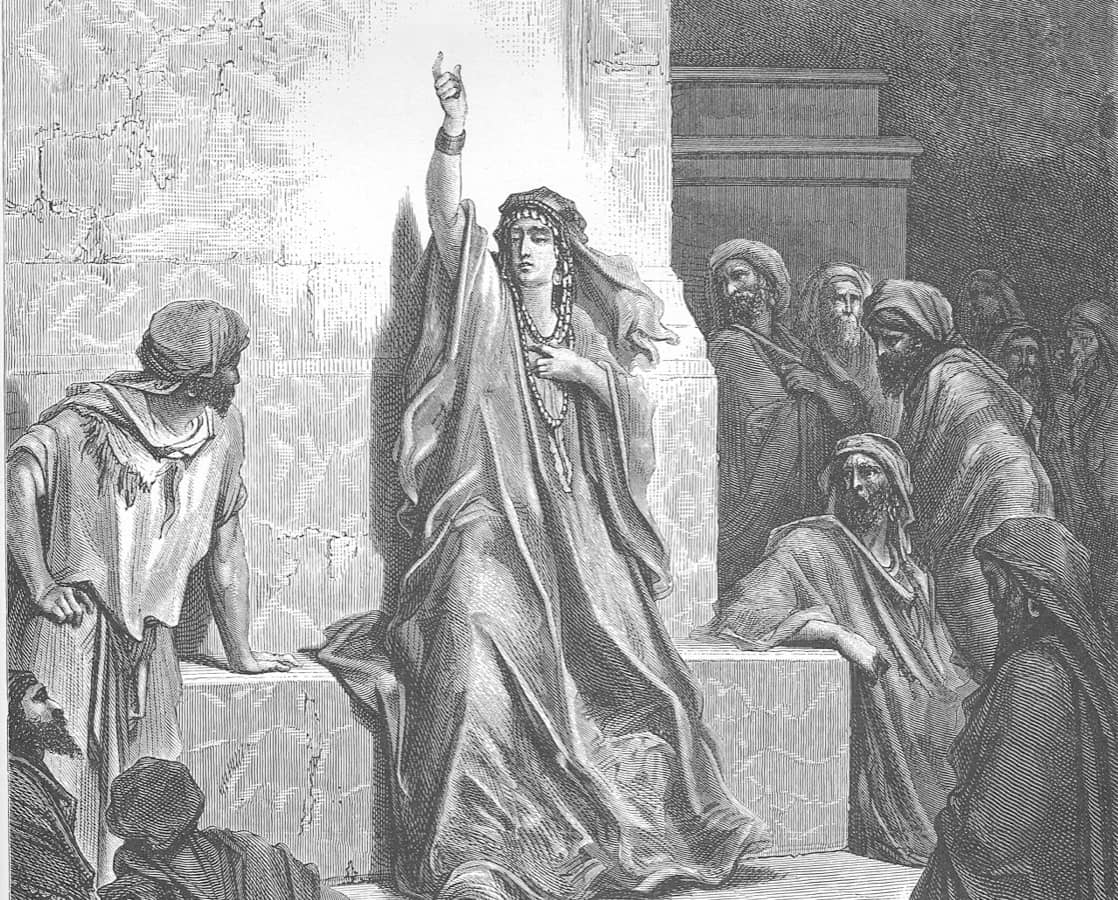
Deborah sings her song after the victory (Judges 5). Engraving by Gustave Doré, 1866.
Read the text carefully. Deborah was "a prophetess" who "judged Israel at that time," and the people came to her under a palm tree for judgement (Judg 4:4-5). But Deborah did not take command of the army. She called Barak and gave him the command of God: "Go and draw toward mount Tabor, and take with thee ten thousand men" (4:6).
The message was clear. The commander was not ready. Barak answered: "If thou wilt go with me, then I will go: but if thou wilt not go with me, then I will not go" (4:8).
Deborah agreed to go. But she told him the cost: "the journey that thou takest shall not be for thine honour; for the LORD shall sell Sisera into the hand of a woman" (4:9).
That woman was not Deborah. It was Jael. Sisera escaped the battle on foot and hid in her tent. She killed him with a tent peg while he slept (4:21). She did not march to the battle. The battle came into her home, and she defended it with the tools that she had. Deborah's song blesses her above women (5:24).
Even then, Deborah did not take Barak's place. Barak led the ten thousand down Mount Tabor (4:14), and Hebrews 11:32 names him among the faithful. God kept His order even when the man in the order failed. The honour that went to a woman was a rebuke to a man who would not go alone.
So Deborah judged. The text says so, and the GKSA's own study deputies wrote in 2009 that she "also served in the ruling office of judge". Nobody needs to explain that away. The question is which office it was. The judges were not elders. "The LORD raised up judges, which delivered them out of the hand of those that spoiled them" (Judg 2:16), and the book ends: "In those days there was no king in Israel: every man did that which was right in his own eyes" (21:25). Samson also "judged Israel twenty years" (16:31), and nobody makes him a model for the church council. The same deputies wrote that the Old Testament offices of king and prophet "cannot be identified directly with the New Testament offices of elder and minister of the Word". Calvin gave the same answer: extraordinary acts of God do not overturn the ordinary rules of government by which He wants us to be bound (commentary on 1 Tim 2:12). Where the New Testament describes the office of elder, it names "the husband of one wife" (1 Tim 3:2), and Paul gives his reason from creation (2:13). Deborah shows that God can call a woman and use her to lead His people. The synod said so itself. She does not show that Christ appointed women as elders.
Think of the ridge again. Suppose a codebreaker brought Edson a message: "The attack comes tonight, on the ridge." And suppose Edson answered: "I will not go up unless you come with me." The Marines would not think less of her. They would lose their respect for the colonel.
This is the honest reading of much of the pressure for VIDA. In many congregations the women carry the work because the men do not come forward. Judges 4 does not answer that problem with a change to the office. It answers it with a call to Barak.
The Silence in the Garden
Barak was not the first man who stood back. That failure began in the garden.
Before Eve was made, God put Adam in the garden "to dress it and to keep it" (Gen 2:15). The Hebrew word for "keep," shamar, means to guard. The Dutch theologian Herman Bavinck writes that Adam received the task "to cultivate and preserve the garden of Eden," and to "protect it against all evil that may threaten it." In Die Kosbare Goud, Ds. L. S. van der Walt keeps both sides of the truth together:
"Adam is die hoof en die vrou is onderdanigheid aan hom verskuldig, want sy is na hom en uit hom geskape. Tog is die vrou ook 'n vry en selfstandige wese onder Adam, die hoof van die menslike geslag."
Then the serpent came. It spoke to the woman, and she ate. Then she gave the fruit "also unto her husband with her; and he did eat" (Gen 3:6). Adam was there, and the text records no word from him. The guard did not guard.
That is why Paul's prohibition reaches back to Eden and not to the customs of Ephesus:
"But I suffer not a woman to teach, nor to usurp authority over the man, but to be in silence. For Adam was first formed, then Eve. And Adam was not deceived, but the woman being deceived was in the transgression." (1 Tim 2:12-14)
Paul's two reasons are the two events in the garden. The first is the order in which God made the man and the woman. The second is the reversal of that order at the fall.
The body matters here as well. Some VIDA arguments treat sex as a fact about the body that has no meaning for a person's calling. Scripture does not separate the two. God made a man and a woman, and He gave His order through that difference. No one on Guadalcanal thought that the difference between men and women was a social construct. Scripture tells us what that difference means.
Christ's Appointment
When God came into the garden after the fall, He did not call the woman first. He called the man: "Where art thou?" (Gen 3:9). The account fell on the head.
The office of elder carries that same account. It is not a seat for the best talent in the congregation. G. P. L. van der Linde writes in his study of Reformed church government:
"Die besondere amp is nie te skei van die algemene priesterskap van die gelowiges nie maar wel daarvan te onderskei as 'n besondere instelling van Christus. Die amp vernietig nie die selfstandigheid van die gelowiges nie maar is gegee ter wille van die gelowiges; nie as hulle organe nie, wel as organe van Christus deur Wie se diens Hy sy hemelse gawes in hulle uitgiet."
The office is not the congregation's voice. It is Christ's instrument, through which He gives His gifts to His people. Thus "who is the most gifted?" is the wrong question. The right question is "whom did Christ appoint?"
The picture of a commander has a limit, and I want to say so myself. An elder's authority is not a commander's authority. Jesus said: "Ye know that the princes of the Gentiles exercise dominion over them ... But it shall not be so among you: but whosoever will be great among you, let him be your minister" (Matt 20:25-26). Peter tells the elders to oversee the flock "neither as being lords over God's heritage, but being ensamples to the flock" (1 Pet 5:3). The authority is real, but it is borrowed. It comes from Christ, the only Head of the church (Belgic Confession, art. 31), and it rules only through His Word (art. 30). An elder rules as a shepherd. But a shepherd is not soft toward the wolf. David kept his father's sheep, and when a lion and a bear took a lamb, "I went out after him, and smote him, and delivered it out of his mouth" (1 Sam 17:34-35). That is the authority the ridge shows: not a man who gives orders, but a man who stands in front of the flock.
And Christ appoints elders to a ridge. Paul told the elders of Ephesus to "take heed therefore unto yourselves, and to all the flock, over the which the Holy Ghost hath made you overseers" (Acts 20:28). Then he warned them that the attack would come from two sides: "after my departing shall grievous wolves enter in among you, not sparing the flock. Also of your own selves shall men arise, speaking perverse things, to draw away disciples after them" (20:29-30). An elder must be able "by sound doctrine both to exhort and to convince the gainsayers" (Titus 1:9). He watches for souls "as they that must give account" (Heb 13:17).
Paul's warning came true in every century. The history of the church is the history of men who held that ridge.
Men on the Ridge
The first attack came from outside. In about AD 155, the Romans arrested Polycarp, the old overseer of the church in Smyrna, in present-day Turkey. The governor offered him his life if he would curse Christ. Polycarp answered: "Eighty and six years have I served Him, and He never did me any injury: how then can I blaspheme my King and my Saviour?" They killed him in front of the crowd in the city's stadium.
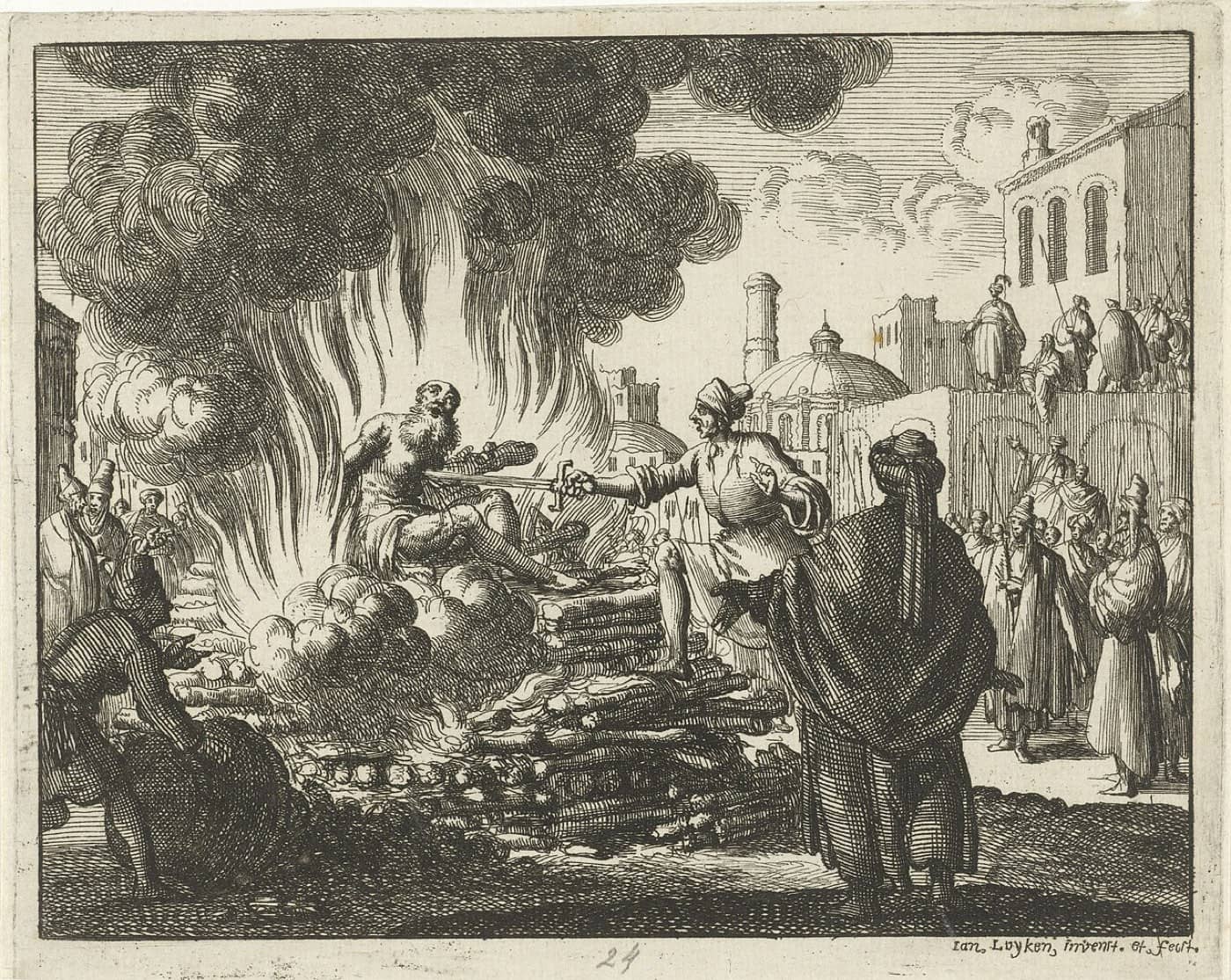
Polycarp on the pyre at Smyrna. Etching by Jan Luyken for the Martyrs Mirror, 1685.
The second attack came from inside, as Paul said it would. In about AD 318, Arius, an elder in Alexandria, taught that the Son of God was a created being. Athanasius, the bishop of Alexandria, refused to yield. Four emperors sent him into exile five times. When we confess in the Nicene Creed that the Son is "very God of very God," we stand on the ground that he held.
In 1561 Guido de Brès, a hunted Reformed preacher in the Low Countries, wrote the confession that every GKSA church still confesses: the Nederlandse Geloofsbelydenis, the Belgic Confession. In 1567 the Spanish authorities hanged him.
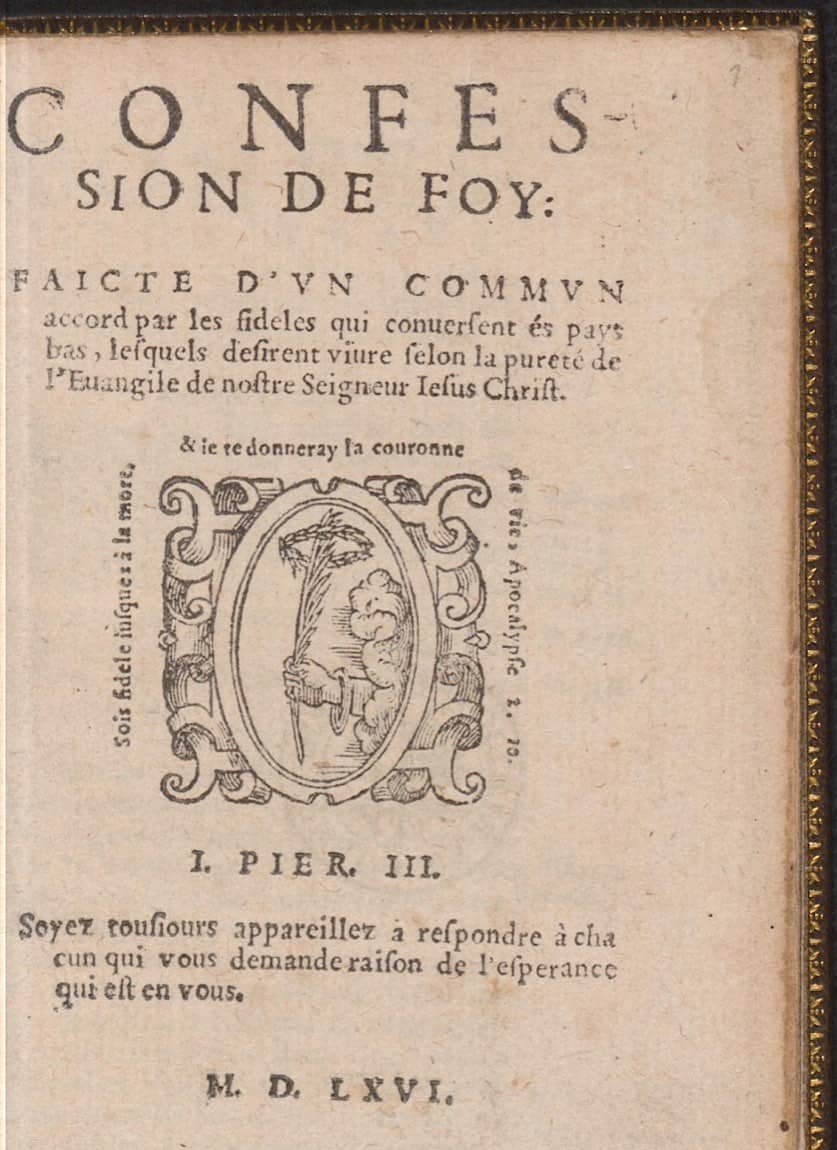
The title page of a 1566 printing of the Belgic Confession. It carries 1 Peter 3:15, "be ready always to give an answer," and Revelation 2:10, "be thou faithful unto death." Revelation 2:10 comes from the letter to the church at Smyrna, the church of Polycarp.
In France, after Louis XIV outlawed the Reformed faith in 1685, a pastor who was caught could be put to death. Pierre Durand was hanged at Montpellier in 1732. His sister Marie held no office, yet she spent 38 years in the Tower of Constance because she would not deny her faith. The brother went to the ridge and died on it. Like Jael, the sister held the place where God put her. Her faithfulness did not need an office to be great, and his office did not make him more precious to God than she was. From 1688, some of their fellow Huguenots found refuge at the Cape. Many South Africans still carry their names, such as du Toit, du Plessis and Joubert.
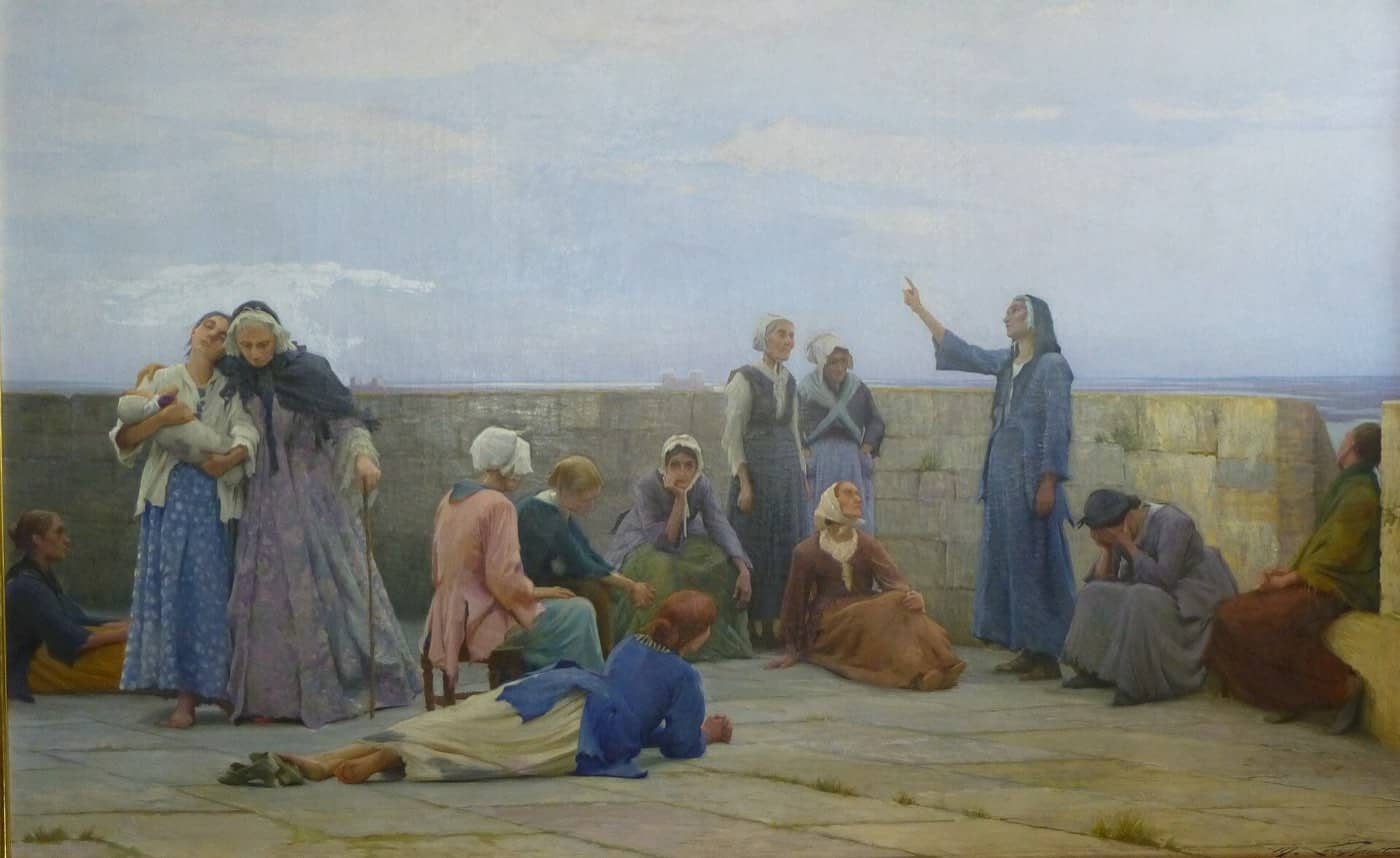
Huguenot women prisoners on the roof of the Tower of Constance. Painting by Michel Leenhardt, 1892.
What Lies Behind the Ridge
Today the ridge runs through consistory rooms and synod halls. In the GKSA, elders who resist VIDA are often called stubborn men who will not share their seats. That charge deserves a straight answer, and the war gives it.
Edson's Ridge itself was worth nothing. It was a strip of grass and coral in the jungle. No Marine died for the ridge. They died for what lay behind it. Just behind the ridge was Henderson Field. If Kawaguchi took the airfield, the Marines would lose the island, and the sea route to Australia would lie open to Japanese bombers.
Behind the debate about women in office lies something larger: how the church reads the Bible.
Paul gives a reason for his command in 1 Timothy 2:12, and the reason is not the culture of Ephesus. It is creation: "For Adam was first formed, then Eve." A church can open the office of elder to women only if it decides that this reason does not bind it. That decision is the real breach in the line. Once a church says that an argument from creation was only an argument for its own time, the same tool reaches every other text that rests on creation. Jesus answered a question about marriage from creation: "Have ye not read, that he which made them at the beginning made them male and female" (Matt 19:4). Paul's teaching on sexuality appeals to what is "against nature" (Rom 1:26).
South Africans have watched this happen. The NG Kerk opened the office of deacon to women in 1982. In 1990 its General Synod opened the offices of elder and minister. In 2015 the General Synod recognised same-sex civil unions, allowed ministers to solemnise them, and dropped the celibacy rule for gay and lesbian ministers. An extraordinary synod reversed that decision in 2016, and in March 2019 the High Court in Pretoria set the reversal aside. At each step the question had the same shape: does a text grounded in creation still bind the church today?
This is not a prediction about every church. Some churches opened the offices to women and went no further. But they stopped because they refused to use the same argument a second time. The argument did not stop by itself.
So here is a question for the reader who supports VIDA. You may want only one thing: a place for the gifted women that you know and love. Most supporters of VIDA want nothing more than that. But which argument will you use to get it? If the argument is "Paul's reason belonged to his culture," then you give the next generation a key that opens every door that God built on creation. You may never want to walk through those doors. Your children will still hold the key.
That is why some elders still hold the line in consistories and synods, although it costs them friendships and their good name. They do not defend their seats. They defend the airfield. The people on the other side of this debate are not Kawaguchi's soldiers. Most of them are brothers and sisters who love the church. But the elders know what lies behind the ridge, and they know that they must give account for it.
The Wapadrant Report
In October 2026, Rapport reported on a document by the four ministers of the Gereformeerde Kerk Wapadrant in Pretoria. Their church has women elders, and the synod's deadline is running. The report calls the GKSA a "dying" federation that loses about 2,000 members a year. It accuses a conservative and "loveless" group of ministers of manipulating decisions "with a majority of votes". And it proposes that the more than R1 million that the church pays to the federation every year could rather be "invested in other kingdom work". The church council has not adopted the report, and one of its signatories calls it a discussion document.
The report is not new. It gathers what others have said for years. In 2018 Dr Wim Vergeer wrote, in a booklet that appears on Wapadrant's own website, that a small group of men had "hijacked" the synod and forced their view on the churches "by a bare majority of numbers". In 2024 Prof. Jacobus Vorster argued in In die Skriflig that consciences may not be bound "by a mere majority vote". In January 2026 an open letter from Gereformeerde women spoke of "synodocracy, in which the independence of the local church is ignored", and called the decision "reckless and loveless". In March 2026 an opinion piece by Prof. Amie van Wyk in Netwerk24 called it "a crude form of synodocracy". In July 2026 the church council of GK George called the ruling "blasphemous". The report deserves an answer, and so do they. (The translations from Afrikaans are mine.)
Synodocracy. Article 84 of the Church Order is clear: "Geen kerk mag oor ander kerke ... enige heerskappy voer nie." But article 86 stands beside it. No single church, classis or synod may change the order on its own, "maar hulle moet hul daarop toelê om dit te onderhou, totdat die algemene sinode anders verorden". A synod that keeps the order that all the churches agreed to rules over nobody. A church that changes the order alone does. When it sends a woman elder to the classis, every other church at that table must accept what it never agreed to. That is the real lordship of one church over the others.
Majority and manipulation. A majority that decides is not a conspiracy. It is the order under which every GKSA church lives. Article 31 says that what a majority decides "sal vir vas en bindend beskou word, tensy bewys word dat dit met die Woord van God of die artikels van die Kerkorde in stryd is". The burden of proof lies on the objector, and by the report's own count the question has been argued for "more than 40 years". The objections were heard, and they lost. The report complains that the ruling leaves no time for another appeal. After more than forty years, that is not a rushed decision. Whoever loses that vote and calls it hijacking or manipulation does not want a fair process. He wants a different result.
"It is not a matter of confession." Vorster and the women's letter both point out that the confessions do not name women in office. That is true, and the 2009 synod accepted it. But the exception in article 31 is not "the confession". It is "die Woord van God of die artikels van die Kerkorde". The confession itself explains why: Scripture is the rule for everything that the church believes and does (Belgic Confession, art. 7), not only for what the confession happens to state. The Church Order is not a confession either, and every church keeps it. A conscience that cannot accept a decision has a lawful road: it objects, it appeals, and if it loses and still cannot submit, it goes in peace. What it may not do is stay and say no. Church law calls that a right of ratification, and even Vorster rejects it, because it makes the decisions of the major assemblies "slegs adviserend van aard".
"Room for another interpretation." Scripture has one meaning. Calvin taught that the true meaning of Scripture is its natural and plain meaning (commentary on Gal 4:22). Two readings that oppose each other cannot both be true. That believers still differ does not prove that Scripture says two things. It proves that we are weak. The GKSA's own study deputies wrote exactly that in 2009: the different readings are "die gevolg van ons onvermoë om die Skrif duidelik te verstaan", and they do not mean that Scripture is "in homself teenstrydig". Weakness does not release a church from a decision. It calls the church to decide: to read, to test one text against the others, and to choose. Vorster asks that such churches be allowed to go on "until" patient conversation settles the difference. But an "until" without a date is not a pause. It is an answer. In 2009 the proposal that each church decide for itself lay before the synod. The advisory committee answered that the office of elder and minister is "nie net 'n saak van die plaaslike kerk" nie (Church Order, art. 30), and the synod did not follow the proposal. Where Scripture leaves room, the GKSA does give it: since 2018 each church decides for itself whether it has women deacons.
Van Wyk points to hats: it took the churches a long time to see that women need not wear hats in worship. That is an honest example, and it shows where the line runs. The head covering was a sign. Paul calls it a sign of authority (1 Cor 11:10), and he grounds it in creation: "For the man is not of the woman; but the woman of the man" (11:8). A church may lay down the sign. It may not lay down the reason. In 1 Timothy 2 there is no sign at all. Paul forbids the thing itself, "to teach, nor to usurp authority over the man" (v. 12), and he gives the same kind of reason: "For Adam was first formed, then Eve" (v. 13). And a classis cannot say yes and no about who may rule at its own table.
The numbers. The GKSA is shrinking, and that is a real sorrow. But the report reads a falling line on a graph as if it were a verdict from God. The Belgic Confession gives the marks of the true church: the pure preaching of the gospel, the pure administration of the sacraments, and church discipline (art. 29). Attendance is not on the list. And if women in office were the cure for decline, the NG Kerk would be the proof. By 1990 it had opened every office to women. Its membership fell from about 1.4 million in 1986 to 691,050 in its own 2019 yearbook.
The money. The report counts the cost of the federation in rand. Edson counted his dead. A federation is not a subscription that a church cancels when the service displeases it. It is a bond between churches that confess the same faith and keep the same order. A church that wants the bond without the order does not want the truth back. It wants its money back.
The slope. The report warns where the synod will go next: women deacons, then the "broers en susters" of the 2020 Afrikaans Bible, then the communion cups, the liturgy and the pulpit Bible. So the authors believe in slippery slopes after all. They see only one direction. They fear a church that moves back toward the text. They do not fear a church that moves away from it, although the NG Kerk went down that second slope in front of every South African.
"Loveless." Love that never says no is not love. "Faithful are the wounds of a friend; but the kisses of an enemy are deceitful" (Prov 27:6). Some go further. Vergeer asked whether the church is becoming a "cult of men" driven by fear. Reading motives cuts both ways, and it answers no text.
Barak hesitated, but in the end he went. He led ten thousand men down Mount Tabor into the battle. This report does the opposite. It wants the church to stop carrying the federation and to stop being one with the other churches. And then it calls that retreat "kingdom work".
Where Art Thou?
Not one of these men held the ridge because of his strength. Polycarp was over eighty. The emperor Julian mocked Athanasius as "a contemptible little fellow." De Brès was a preacher who lived in hiding. They held the ridge because Christ had put them there, and they knew that they must give account.
Nehemiah knew where that weight belongs. When enemies threatened Jerusalem while its wall was half built, he set the people at the low and exposed places of the wall, "after their families with their swords, their spears, and their bows." Then he told them: "Be not ye afraid of them: remember the LORD, which is great and terrible, and fight for your brethren, your sons, and your daughters, your wives, and your houses" (Neh 4:13-14). God does not ask men to stand on the wall for their wives and daughters, and then send those wives and daughters to stand in the breach of the church.
Headship is not a privilege to grasp. "Husbands, love your wives, even as Christ also loved the church, and gave himself for it" (Eph 5:25). In Scripture the head goes first into danger, and he carries the account when things go wrong.
On the morning of 14 September 1942, the Marines on Edson's Ridge counted their dead. The colonel who stood behind the line all night now had to answer for every one of them. He did not carry that weight for its honour. He carried it because it was his post.
I write this as an elder. I have served in that office for two years. In that short time I have seen things in my own church, in my ward and in our federation that brought me close to giving up. More than once I have thought that it is not worth it, and that someone else can carry it. I am tired, and I am often frustrated.
But the soldiers on Edson's ridge were tired too. Nobody asked them whether they felt like holding the line. They held it because it was their post, and because they knew what lay behind them. Christ has given me a post. I cannot hand it back because it has become heavy. If this is the hill, then I will die on it.
Through Ezekiel, God described the man He looks for: "And I sought for a man among them, that should make up the hedge, and stand in the gap before me for the land, that I should not destroy it: but I found none" (Ezek 22:30).
The church does not need more men who want a seat on the council. It needs men who will go up the ridge when the word of God calls, and who will not ask the women of the church to carry what God gave them to carry. In every consistory and every home, God still asks His men the question that He first asked in the garden: "Where art thou?"
Sources
- Ruhan Friedrichs, "Dopper-leraars: Hou op om R1 miljoen aan 'sterwende' GKSA te betaal", Rapport, October 2026.
- Arnold Griesel, "Krimpende lidmaatgetalle is iets om oor kleinserig te raak", Kerkbode, 14 January 2023.
- Kerkorde van die Gereformeerde Kerke in Suid-Afrika, arts. 31, 84 and 86.
- Acta van die Algemene Sinode van die Gereformeerde Kerke in Suid-Afrika, 2009, pp. 529, 652, 662 and 665.
- John Calvin, Commentary on Galatians, on 4:22.
- John Calvin, Commentary on 1 Timothy, on 2:12.
- Wim Vergeer, Gereformeerde vroue word wakker, March 2018 (wapadrant.co.za).
- Jacobus M. Vorster, "Die begrippe 'gemeen akkoord' en 'buite kerkverband plaas' in kerkregtelike perspektief", In die Skriflig 58(1), 2024.
- "Ope brief: Luister na ons, vra lidmate", Maroela Media, 30 January 2026.
- Amie van Wyk, "Besluit oor vroue 'n growwe vorm van sinodekrasie", Netwerk24, 30 March 2026.
- "Congregations challenge GKSA ruling on women serving as elders and ministers", George Herald, 30 July 2026.
- The Martyrdom of Polycarp, ch. 9.
- Herman Bavinck, The Wonderful Works of God, ch. 12, trans. Henry Zylstra.
- L. S. van der Walt, "Die Oorsprong, Wese en Bestemming van die Mens," in Die Kosbare Goud (Gereformeerde Geloofsleer), p. 82.
- G. P. L. van der Linde, Die grondbeginsels van die Presbiteriale kerkregeringstelsel (Pro Rege, 1965), pp. 51-52, quoted in Jan Visser, Kerklike Tug: Wat sê die Nuwe Testament?, p. 65.
Scripture quotations are from the King James Version.
Image credits
- Bloody Ridge, 15 September 1942: photograph by Thayer Soule, Archives Branch, USMC History Division, CC BY 2.0, via Wikimedia Commons.
- Marines on patrol, August 1942: official US Marine Corps photograph, public domain.
- Colonel Edson, 1943: US Navy photograph 80-G-43481, public domain.
- Colossus at Bletchley Park: The National Archives (UK), FO 850/234, public domain.
- Deborah: Gustave Doré, 1866, public domain.
- Polycarp: Jan Luyken, 1685, Rijksmuseum, public domain.
- The Belgic Confession, 1566: public domain, via e-rara.ch.
- The Tower of Constance: Michel Leenhardt, 1892, public domain.