
apologetics
How to talk to a Jehovah's Witness | Internal contradictions in WTBTS doctrine and teachings
Arne Verster10 min read
Contents8 sections
Aa
Our first article on the Jehovah's Witnesses examined their "proof texts", the passages they use to argue against the divinity of Christ.
This one sets out a series of problems within the Jehovah's Witness system, several of which are not widely known inside the community itself. Read it alongside our initial article, which is best read first: together they equip you to defend the Gospel and to show where Jehovah's Witness belief breaks down.
In the following post, red text indicates official Watchtower content or statements.
Remember to prioritize the Gospel in your discussions with Jehovah's Witnesses. Dismantling their worldview without offering the Gospel in its place achieves nothing of lasting value.
Problem 1: Who/what is the authority of the JW?
Ask the Jehovah's Witness where his authority lies. The answer will usually be one of two:
- The Bible
- The Watchtower
The Watch Tower Bible and Tract Society prohibits the reading of external literature, asserting that solitary study of the Bible results in apostasy. But its history of inaccurate prophecies undermines its own claim to exclusive authority and truth. Either answer, then, lands the Jehovah's Witness in a contradiction.
Not only do we find that people cannot see the divine plan in studying the Bible by itself, but we see, also, that if anyone lays the “Scripture Studies” (his books) aside, even after he has used them, after he has become familiar with them, after he has read them for ten years – if he then lays them aside and ignores them and goes to the Bible alone, though he has understood his Bible for ten years, our experience shows that within two years he goes into darkness. On the other hand, if he had merely read the “Scripture Studies” with their references and had not read a page of the Bible as such, he would be in the light at the end of two years, because he would have the light of the scriptures.
Watchtower, Sep. 15, 1910, p. 298
If they claim Scripture as their authority, they contradict their own doctrine. If they name the Watchtower instead, its history of false prophecies stands against it. That second horn leads directly into the next problem.
Problem 2: The WTBTS claims to be a prophet.
So, does Jehovah have a prophet to help them, to warn them of dangers and to declare things to come? These questions can be answered in the affirmative. Who is this prophet? . . . This "prophet" was not one man, but was a body of men and women. It was the small group of footstep followers of Jesus Christ, known at that time as International Bible Students. Today they are known as Jehovah's Christian witnesses . . . Of course, it is easy to say that this group acts as a "prophet" of God. It is another thing to prove it...
Watchtower, Apr. 1, 1972, p. 197.
Deuteronomy 18:20-22 gives the criteria for telling a true prophet from a false one:
But the prophet who presumes to speak a word in my name that I have not commanded him to speak, or who speaks in the name of other gods, that same prophet shall die.’ And if you say in your heart, ‘How may we know the word that the Lord has not spoken?’— when a prophet speaks in the name of the Lord, if the word does not come to pass or come true, that is a word that the Lord has not spoken; the prophet has spoken it presumptuously. You need not be afraid of him.
Deuteronomy 18:20-22***, English Standard Version (ESV)***
The organization has acknowledged significant inaccuracies in its own predictions. In "Man’s Salvation Out of World Distress!", released in 1975, they confess to several mistaken forecasts made over the years. They concede that Charles Taze Russell, the founder of the movement, wrongly predicted Christ’s second coming in 1874, and they acknowledge incorrect predictions for 1914, 1925 and 1975 regarding significant biblical events. [1][2][3]
In May 1974 the Watch Tower Society told members regarding the 1975 date that:
Reports are heard of brothers selling their homes and property and planning to finish out the rest of their days in this old system in the pioneer service. Certainly this is a fine way to spend the short time remaining before the wicked world's end.
"How Are You Using Your Life?". Our Kingdom Ministry. May 1974. p. 3.
The disappointment stemming from the unfulfilled prophecy of 1975 led to a decline in the number of Jehovah's Witnesses starting from 1976, a trend that continued until it began to reverse in 1980. [4]
This presents a profound challenge to the Jehovah's Witness belief system. On the one hand, their adherence to the Bible as the ultimate source of truth is called into question by the Watchtower's own statements, which say that solitary study of the Bible can lead to apostasy. On the other hand, the Watchtower's credibility as a prophetic authority is destroyed by its admissions of error, since it fails the standard set by the Bible itself. That leaves the adherent with no authority he can appeal to, and therefore no way to justify the foundations of what he claims to know.
Problem 3: The JW confesses that God is only one person within the one being that is God, compared to the Scriptural teaching that God is three persons within the one being that is God.
The initial article covers this at length. Here our focus is on God's love. Ask the Jehovah's Witness whether he believes God is love. If he affirms it, explore what love requires given God's oneness. For God to be love in Himself, there must be a plurality within His being, because love by its nature requires an object. If God has always been love, even before the creation of mankind, there must always have been a plurality within Him for that love to be directed towards. Without it, God before creation had no one to love, and "God is love" becomes an empty claim.
Christian doctrine holds that God's capacity to love does not depend on any being outside Himself. The Trinity, three distinct persons within one divine essence, is what makes this coherent. God is love independent of anything or anyone outside Himself. He is eternally satisfied and completely self-contained. His love is not dependent on objects of love, but is an eternal aspect of His being, expressed in the relations between the persons of the Trinity.
Problem 4: Ask the JW whether God can die.
The NWT claims God cannot die.
Are you not from everlasting, O Jehovah? O my God, my Holy One, you do not die. O Jehovah, you appointed them to execute judgment; My Rock, you established them for punishment.
Habakkuk 1:12***, NWT***
The NWT claims God (the Alpha and Omega) died.
“I am the Alpha and the Omega,” says Jehovah God, “the One who is and who was and who is coming, the Almighty.”
**Revelation 1:8, **NWT
When I saw him, I fell as dead at his feet. And he laid his right hand on me and said: “Do not be afraid. I am the First and the Last, and the living one, and I became dead, but look! I am living forever and ever, and I have the keys of death and of the Grave.
Revelation 1:17-18***, NWT***
This of course amounts to a contradiction if you deny the divinity of Christ, who died as per his human nature.
Problem 5: Changes to Watchtower doctrine.
Regarding the 1914 date:
But bear in mind that the end of 1914 is not the date for the beginning, but for the end of the time of trouble.
After the 1914 prophecy failed to come true, they changed their stance:
Jehovah's witnesses pointed to the year 1914, decades in advance, as marking the start of the conclusion of the system of things.
One counterpoint comes up often enough to be worth answering. Some Jehovah's Witnesses will insist that 1914 was never predicted to be the end of times. Their own documents contradict this. "Studies in the Scriptures - Thy Kingdom Come," released before 1914, treats that year as decisive for end-time prophecy.
That the deliverance of the saints must take place some time before 1914 is manifest...
And the post-1914 version (1923) indicates:
That the deliverance of the saints must take place very soon after 1914 is manifest...
"Some time before 1914" and "very soon after 1914" cannot both be the prophecy. The change is not a refinement of wording but a direct reversal of doctrine after the event failed to arrive.
Problem 6: Jehovah's Witnesses are not to read any material given to them by apostates.
It would be a mistake to think that you need to listen to apostates or to read their writings to refute their arguments. Their twisted, poisonous reasoning can cause spiritual harm and can contaminate your faith like rapidly spreading gangrene. (2 Timothy 2:16, 17) Rather, imitate God's response to apostates. Job said of Jehovah: "Before him no apostate will come in." - Job 13:16."
Watchtower** 2004 Feb 15 p.28**
There are numerous other quotations to the same effect, which can be found here.
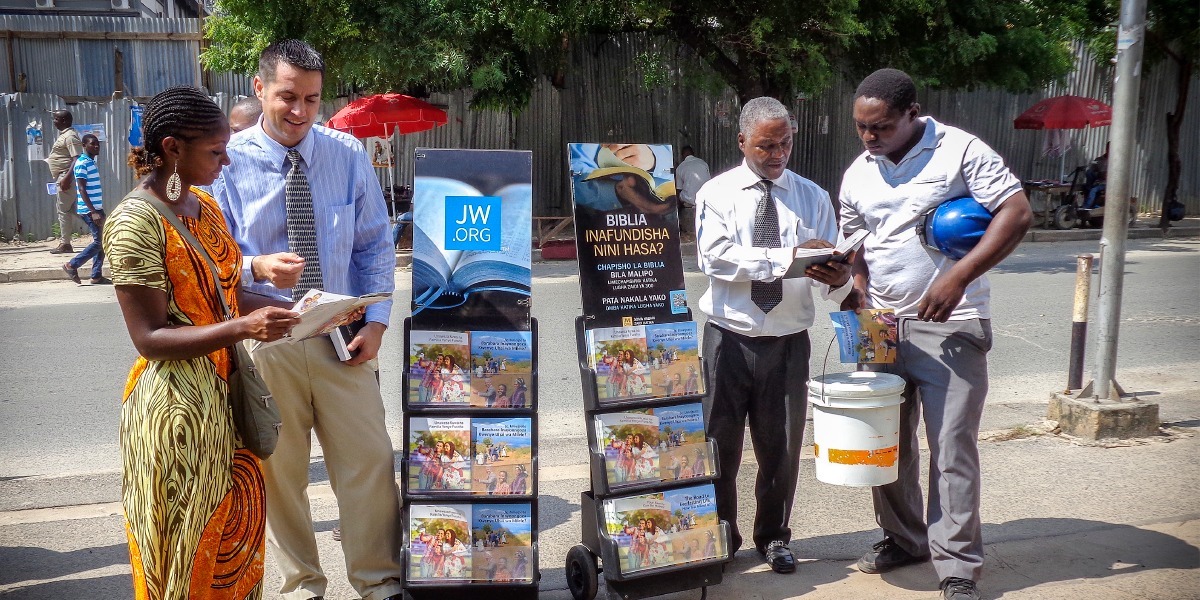
The contradiction here is straightforward. Jehovah's Witnesses regularly direct people to their official website, JW.org, and expect them to read their materials. Applied consistently, their own rule forbids exactly what they ask of everyone else.
The rule is also at odds with the Apostle Paul. Paul cited pagan philosophers, not to endorse their views but to use their own statements in defence of the gospel. He referenced Epimenides, Menander and Aratus, which means he had read and understood them well enough to quote them in context and turn them to his purpose.
If Paul found value in this, then reading widely and with discernment has a legitimate place in theological discussion: quoting a source in its proper context to expose an error, or to build a bridge for the gospel. That leaves Jehovah's Witnesses caught between the scriptural example and the rule laid down in their own publications.
Conclusion
Jehovah's Witness doctrine is riddled with contradictions. A worldview built on contradictory foundations cannot hold together, and reduces to absurdity when pressed. Their teachings therefore offer no solid basis for knowledge at all.
But moving someone from "my system is inconsistent" to "Christ is Lord" is not automatic. Exposing the flaws in a worldview does not by itself win anyone to the gospel, so the gospel must be preached deliberately. Do not assume your Jehovah's Witness knows the true message of Christ: the vocabulary overlaps, the content does not. Set out plainly what Christ accomplished on the cross.
Do all of this with love and respect. Grace, not argument, is what changes a person, and any one of us could hold and promote error apart from God's intervention. Tracts and other summary materials are useful for putting the core of the gospel into their hands.
References
- Man’s Salvation Out of World Distress at Hand, op. cit., p. 312.
- 1975 Yearbook of Jehovah’s Witnesses (WBTS, 1974), p. 76.
- Ibid., pp. 145-146.
- Singelenberg, Richard (1989). "It Separated the Wheat From the Chaff: The 1975 Prophecy and its Impact Among Dutch Jehovah's Witnesses". Sociological Analysis. 50 (Spring 1989): 23–40.